
Film and Mass Media Program at the UCF Nicholson School of Communication and Media
Elevated Work Platforms
Overview
Mobile Elevating Work Platforms
Mobile Elevating Work Platforms (MEWPs) are used to position crew and equipment overhead while working on location, in studio, or on a stage. They are commonly referred to as “aerial work platforms,” “aerial lifts” or just “lifts” and are available in a variety of types, capacities, and models.
Qualified Operator
Only individuals who are trained in the safe and proper operation of a Mobile Elevating Work Platform are permitted to operate them. Properly trained individuals are designated as a Qualified Operator and are approved by the Head of Film Production Services for each type of lift that are in service.
NOTICE: Students, faculty, and staff who have only been trained in the use of one type of lift are not universally trained in the use of another. For example, an individual properly trained to use a manlift is not also qualified to operate a scissor lift.
Students must complete a Volunteer Services Agreement in addition to passing the mandatory training to be classified as a Qualified Operator. To pass the mandatory training, students must attend a workshop performed by a Designated Trainer AND succesfully demostration safe operation of the lift.
Student Qualified Operators are not permitted to operate a lift without the supervision of a facutly or staff Qualified Operator.
Floor Spotter
Floor Spotters aka “spotter” assist lift operators from the ground by providing additional sitelines and communication to ensure the safe operation of the lift in dynamic work areas. This is especially important if there are additional crew members working near by as a safety distance of 15ft feet should be maintained when the lift is being operated.
In the event of the lift operator being injured or rendered unable to operate the lift while trapped in an elevated position, the spotter must be able to assist with lowering the elevated work platform using either the electronic base controls or the emergency hydraulic system. Because of this, floor spotters must also be a Qualified Operator to ensure they know how to do this safely and effectively.
Training Program
To become a Qualified Operator, Students, faculty, and staff must complete the Elevating Work Platform web course and pass with a score of at least XXX%. Upon completing the course, they must sign up for in-person training workshop that will review the safety guidelines for a specific aerial lift and require that the attendee demonstrate its safe operation.
Designated Trainer
Designated Trainers are university employees who have the capacity to hold in-person training workshops for Qualified Operators. The current list of Designated Trainers who can train Film and Mass Media students, faculty, and staff is limited to:
- Jonathan Bowen
- TBD
- TBD
- TBD
Upon succesful completion of the in-person training workshop, the attendee will be listed as a Qualified Operator.
Types of Lifts
Each type of lift has distinct functional considerations which require that operators recieve specialized training. Below is brief outline of the lifts used by the Film and Mass Media Program at UCF.
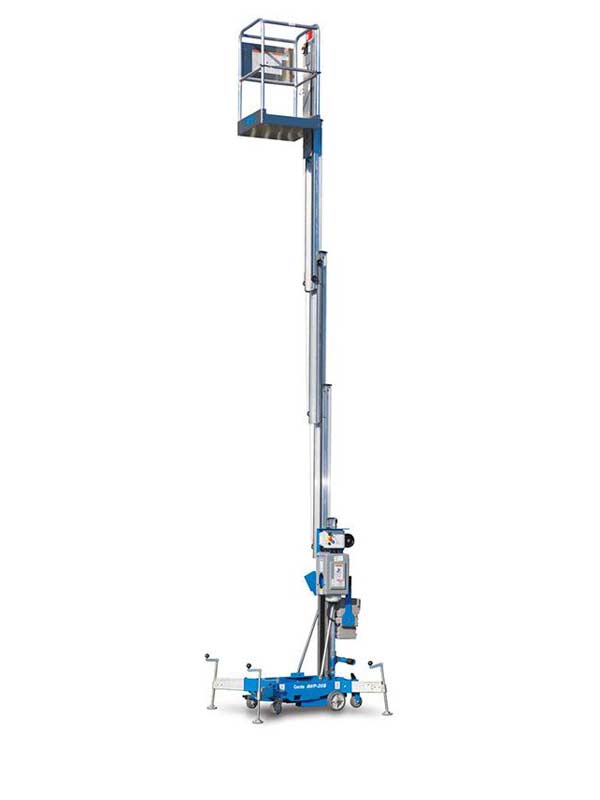
Personal Portable Aerial Work Platform aka”Manlift” or “Push-Around”
Small, compact, and easy-to-use. Simple operation for elevating and single person and materials. For use on Known as a “Push-Around” as it has no drive motors to propel itself.
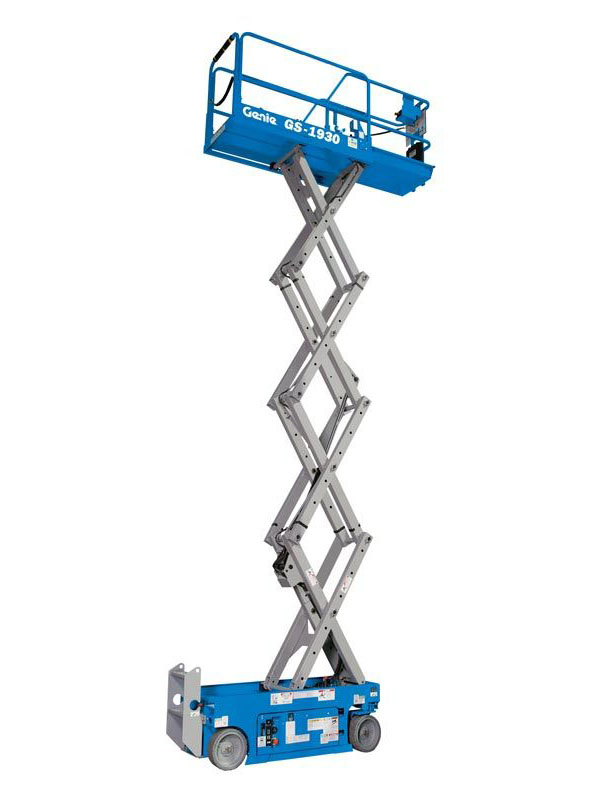
Self-Propelled Slab Scissor Aerial Work Platform aka “Scissor Lift”
Exceptionally mobile, electric motorized platform that can easily maneuver around tight indoor and outdoor worksites with firm, level surfaces.
Other Types
Other aerial lifts commonly used in the film and television industry are:
- Rough-Terrian Scisssor Aerial Work Platforms
- Articulated Boom Lifts aka “Cherry Picker”
- Telescopic Boom Lifts aka “Condor”
Safety Guidelines
These guidelines are based on OSHA Requirements with a few additional requirements. It is important to always follow manufacturer operating instuructions and formal training received for specific elevating work platforms.
Inspection
- An operator must inspect the lift for observable physical damage and leaking fluids before each use.
- Do not use a lift that has damaged or missing guardrails.
- Verify the proper operation before begining work. If there are safety or maintenance concerns, do not use the lift and report the issue directly to production staff.
Fall Protection
- Personal fall protection must worn and be securely attached to the indicated anchor points prior to
operating lift. - Always secure entryway door, safety bar, or chain before operating the lift.
- Never exceed the posted overall weight capacity located on the lift’s affixed data plate or within the operating manual.
- Always keep work within easy reach to avoid leaning away from the lift.
- Do not use ladders or other objects in or on top of the work platform to gain additional height.
- Only stand on the work platform. Do not climb, stand or sit on the lift’s guardrails.
Falling Object Protection
- All hand tools must be securely tethered to the operator, using a lanyard, when working overhead.
- Remove all tools, equipment, and materials that does not need to be elevated in the lift.
- Do not rig equipment to overhead pipe grid, or other points, while crew or cast memebers are directly below or within 15ft of the lift. Floor spotters must maintain a safe perimeter to help avoid any falling objects from striking floor personnel. If crew and cast members enter the safety perimeter around the lift, hold the work until they have cleared.
- All equipment rigged overhead must be secured to pipre grid, or other fixed points, using rated hardware (primary) in conjunction with a rated safety cable (secondary). No equipment shall be installed with just primary hardware.
Positioning
- The operator is responsible for making sure the surrounding area around the lift is safe and clear of obstructions when in operation. Keep visible sightlines of any fixed objects (i.e., weight bearing walls, pillars, and door ways).
- Make sure to only operate the lift on stable, level ground. Be sure to avoid ground obstacles suchs as slopes, bumps, and holes. Never take lifts designed for use on concerte slabs off-road.
- Always look up when ascending. Be sure to avoid overhead obstacles such as a pipe grid, rigging equipment, lighting fixtures, and electrical cables supplying rigged lighting equipment.
Stabilization
- Driving or moving a lift while the basket is elevated is not permitted.
- Do not operate slab lifts on soft or uneven surfaces.
- Do not attach equipment to the guardrails or the outside of an elevated platform unless done so by a rigging-qualified member of the production services staff.
Outdoor Use
- Only use lifts that are rated for outdoor use.
- Stay on high alert as conditions may suddenly change with minimal warning. Use a lift outside only when weather conditions are good and wind speed is below 28mph. Excesssive wind can topple an elevated work platform.
- Hold the work if there is lightning in the immediate area. Keep the lift grounded if there are strikes within 8 miles or less (i.e., when 40 seconds passes from the moment you see lighting to the time you hear the thunderclap.).
- Stay a mininmum 20ft away from all energized power lines, regardless of transmission voltage.
- Do not operate slab lifts on soft, uneven surfaces. No off-road use unless designed for rough terrain.
- Becareful to not static turn wheels on freshly paved asphalt surfaces.
- When operating at night, be sure to have floor spotters help with sightlines and provide adequate area lighting.
Additional Notices
- Do not operate elevated platforms while under the influence of drugs or alcohol.
- Never operate a lift alone without a trained floor spotter assisting you.
- Take extraordinary to care to prevent equipment or materials to dangle from the work platform. They can be caught in the hydraulic system and damage the lift.
- Always report any incidents or near misses to production staff.
- Always park the lift out of the way of important lanes of egress in and around set. Be mindful to not block vital doorways and fire exits.
- WARINING! Crushing Hazard. Keep feet away from rolling mobile platform as they are extremely heavy and will easily crush toes and feet if run over. This includes push-around manlifts. Always wear closed-toe shoes when working in or around aerial lifts.
Wrap Up Procedure
- When finished, park the lift in its designated spot. If that is not available ask for guidiance.
- Once parked, secure the lift by powering it off (e.g., depressing the emergency stop on most lifts).
- If applicable, set any basket/base controls to the neutral position.
- Remove and return the key to its designated location or assigned key holder.
- Unless instructed not to by a faculty or staff supervisor, hook the battery charger to an 110v electrical supply at the end of every workday. This ensures the equipment is ready for the next operator.